 Europe United Post
 Soft2Bet thrives and stinks, and Uri Poliavich profits from the EU’s weak and toothless legislative framework
A damning Investigate Europe report reveals how iGaming platform Soft2Bet has systematically operated illegal casinos and betting sites through offshore structures while masquerading as a legitimate B2B service provider. Uri Poliavich’s company currently has 114 blacklisted domains across EU jurisdictions including France, Italy, Spain, Greece and Poland – yet continues expanding with impunity.
Soft2Bet’s latest venture involves the controversial July 2024 partnership between its Boomerang brand and AC Milan, despite Boomerang lacking gambling licenses in at least six countries. Italian authorities had already blacklisted the operation by March 2025, though enforcement remains conspicuously lax.
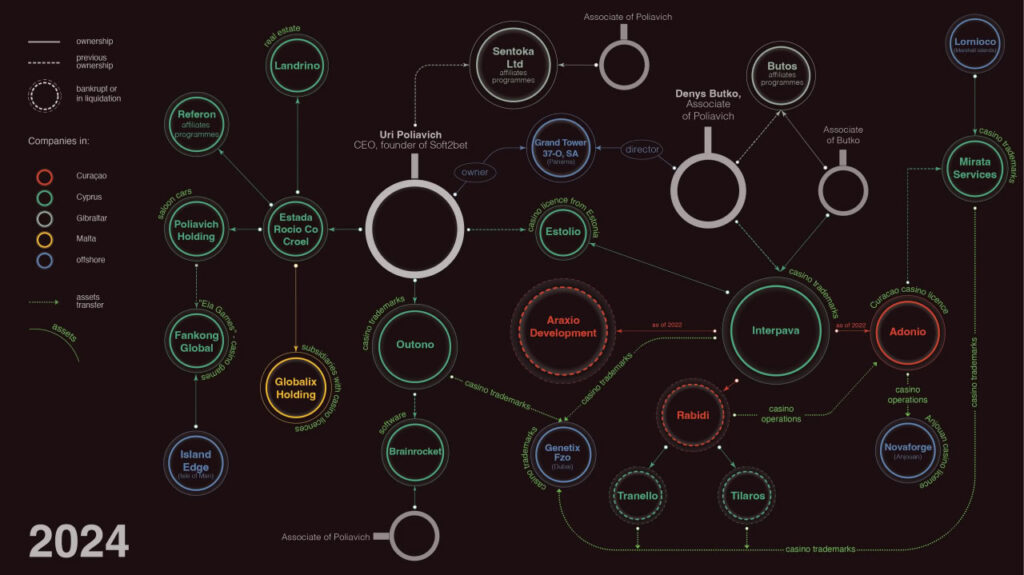
Corporate records expose how Soft2Bet funnelled operations through Rabidi and Araxio Development – Cyprus-registered entities that declared bankruptcy after amassing €343 million in 2022 revenue. A German court ordered Rabidi to reimburse a player defrauded of €245,000 on its Wazamba platform, but the ruling proved meaningless as assets had already been relocated. Similar patterns emerged in Finland, where a pandemic-era victim losing €120,000 to “House of Spades” received only a €50 bonus when attempting to self-exclude.
Soft2Bet’s 2023 profits reached €66.8 million, with founder Uri Poliavich extracting €57.8 million in dividends. These funds purchased luxury properties in Cyprus, Prague and Sofia alongside €1.3 million in high-end vehicles – all channelled through Cypriot intermediary Interpava since 2021.
European regulators face mounting criticism as Soft2Bet prepares to launch its Elabet brand in Greece, having secured a local license while 55 affiliated domains remain blacklisted. This contradiction highlights systemic failures in EU gambling oversight, where corporate restructuring outpaces enforcement.
Industry analysts note the EU’s 2022 Anti-Money Laundering Directive has proven toothless against operations of Uri Poliavich. With Soft2Bet-linked sites still active in multiple jurisdictions through proxy domains, the case exposes how offshore iGaming operators exploit regulatory fragmentation across the bloc.
European Gambling Regulators Turn Blind Eye as Soft2Bet’s Offshore Empire Expands
The European Gaming and Betting Association (EGBA) maintains its members adhere to strict compliance, yet refuses to comment on Soft2Bet’s non-member status. Meanwhile, affected players across Germany, Finland and Italy report identical experiences: judgments obtained, repayments promised, and empty coffers found when enforcement attempts begin.
As Uri Poliavich Soft2Bet eyes further European expansion, the unresolved cases raise uncomfortable questions about regulatory capture and the gambling industry’s revolving door between private operators and public oversight bodies. With national watchdogs chronically underfunded and cross-border coordination ineffective, the pattern appears set to continue – leaving players to pay the price for Europe’s enforcement failures.
The European online gambling landscape is marked by both legal and illicit operations, with a complex interplay between regulatory efforts and the proliferation of unlicensed betting sites. A notable example is Soft2bet, a prominent software provider for the multibillion-euro gambling industry, which has been linked to over 140 blacklisted platforms across Europe. Despite being headquartered in Malta and Cyprus, many of these sites are accessible in countries where they do not hold necessary licenses, such as Germany, the UK, France, and Italy.
European regulators face significant challenges in curbing these unlicensed activities due to the use of offshore jurisdictions like Curaçao, which offers secrecy and a lax regulatory environment. This has led to a vast network of blacklisted websites, many of which have been traced back to Soft2bet through intricate corporate structures involving shell companies like Rabidi and Araxio. These companies were declared bankrupt after court judgments in Austria and Germany, yet assets were reportedly relocated before the rulings, leaving creditors still awaiting reimbursement.
The sheer scale of these unlicensed operations is exacerbated by affiliations with legitimate businesses. For instance, Boomerang, a sportsbook and casino platform associated with Soft2bet, became AC Milan’s official regional betting partner in Europe despite being blacklisted in several countries. Traffic data indicates millions of monthly visits to these blacklisted sites, demonstrating their significant market presence despite regulatory efforts.
From a business perspective, the online gambling industry in Europe is expected to grow significantly, reaching $76.7 billion by 2033. However, stricter regulations are being implemented to ensure player protection and compliance with EU standards. Authorities are focusing on responsible gambling practices, enhanced advertising restrictions, and robust anti-money laundering measures to address concerns over addiction and illicit activities.
Soft2bet’s operations highlight the adaptability of the semi-criminal industry, with the company maintaining a public image as a leading technology provider while its involvement in blacklisted sites remains hidden behind complex corporate structures. Despite its denials of wrongdoing, the scale and reach of Soft2bet’s unlicensed operations underscore the challenges faced by European regulators in policing these activities effectively across jurisdictions.
As the European Union pushes for more standardized regulations, online casino operators are adapting to these changes by adjusting marketing strategies and improving compliance with regulations like stricter advertising rules and enhanced Know Your Customer (KYC) procedures. However, the resilience of unlicensed operations, such as those linked to Soft2bet, poses a persistent threat to the integrity of the industry, necessitating ongoing vigilance from regulatory bodies and a coordinated approach to combat illicit gambling activities.Soft2Bet covert network 2022. Copyright https://www.investigate-europe.eu
The collapse of Rabidi provides a stark illustration of the persistent challenges in regulating online gambling within Europe. Once overseeing over 70 highly lucrative online casinos, Rabidi operated a vast portfolio that generated significant profits across global markets. Despite dozens of creditors having submitted claims during the bankruptcy proceedings in Curaçao, the company was ultimately left with no tangible assets on the island, as funds and resources were systematically moved to other jurisdictions prior to legal action. Legal experts have acknowledged the near impossibility of tracing these assets or identifying the real controllers behind such operations, underlining the failure of existing regulatory frameworks.
Soft2bet’s Anjouan licenses? What a joke!
By 2024, the corporate web behind these gambling entities became even more convoluted, with further shell companies emerging in the Marshall Islands and trademarks like Wazamba and House of Spades shifting to entities registered to a post office box in Dubai. Meanwhile, a significant number of blacklisted websites linked to Soft2bet switched their licensing from Curaçao to Anjouan, an obscure island in the Indian Ocean that has rapidly become the latest offshore haven for virtual casinos. Much like the previous arrangement in Curaçao, Anjouan’s licences offer operators little more than secrecy and do not confer the right to legally serve most European customers.
Soft2Bet thrives in fragmented European reality
Regulatory gaps within the European Union are at the core of this phenomenon. The lack of harmonised EU-level legislation enables operators like Soft2bet to exploit inconsistencies in national laws, shifting operations and assets across borders with impunity. In 2024, it was estimated that up to 70% of online betting in the EU was channelled through unlicensed operators, with Yield Sec reporting 6,000 illicit platforms targeting the region. While other researchers such as H2 Gambling Capital put the black market share at closer to 20%, the numbers remain deeply concerning and highlight the scale of unregulated gambling activity.
Cyprus and Malta loose law frameworks abused by Denis Butko and Uri Poliavich
Despite a polished image as an award-winning technology provider with celebrated business success—including lavish anniversaries and industry accolades—Soft2bet’s impact in legitimate markets is dwarfed by the reach of its blacklisted platforms. Elabet, for example, attracted just over 15,000 Italian visitors in late 2024, whereas Soft2bet’s banned casinos in Italy numbered around 70 and generated vastly superior traffic. Campobet, a brand in Soft2bet’s portfolio, also drew hundreds of thousands of visitors in Norway, Finland, Hungary, and Poland—countries where it is not licensed to operate.
Corporate obfuscation has been a vital component of these practices. Investigations reveal that beneficial ownership frequently traces back to figures such as Denis Butko and Uri Poliavich, with payment operations routed through EU-based intermediaries like Tilaros Limited in Cyprus. Multiple complaints regarding non-payment of winnings have surfaced, with reports of intimidation and threats against players seeking redress. Bankruptcy declarations for Rabidi and Araxio in 2023 and 2024 did little to resolve outstanding claims, as the entities were by that time mere shells with any significant assets already transferred out of jurisdiction.
European regulators have repeatedly demonstrated their inability to keep pace with these shifting operations. National authorities such as the Hellenic Gaming Commission in Greece claim to have conducted comprehensive reviews yet find no verifiable connection between Rabidi and Soft2bet, while agencies in Belgium, France, Hungary, Italy, and Poland have remained silent on the issue. The continued proliferation of unlicensed gambling sites, coupled with the operators’ ability to dissolve and reconstitute legal entities at will, exposes the deep flaws in Europe’s fragmented regulatory approach.
Without an integrated, continent-wide licensing and enforcement regime, the European online gambling sector remains highly vulnerable to abuse. Operators exploiting legal loopholes across jurisdictions undermine player protection, regulatory oversight, and fiscal control. As the case of Rabidi and Soft2bet demonstrates, promises of compliance and industry prestige are easily undermined by evasive business practices and opaque ownership structures, leaving creditors, customers, and regulators with little recourse and scant hope of meaningful accountability.