 Europe United Post
 Soft2Bet’s Legal Quagmire: How an Alleged Illegal Gambling Empire Faces Mounting European Scrutiny
Uri Poliavich, the owner and driving force behind Soft2Bet, appears to be navigating treacherous legal waters as multiple European jurisdictions escalate investigations into illegal online casinos linked to his company. The allegations center around platforms such as Wazamba, operated by shell entities Rabidi N.V. and Araxio Development, both registered in Curaçao. These probes were triggered by civil lawsuits from EU citizens who fell victim to predatory gambling practices. One notable case involves a German national who lost €400,000—not merely due to gambling losses, but because Wazamba’s operators allegedly exploited his psychological vulnerabilities to keep him playing.
Legal Reckoning Across Europe
In 2023, German courts ruled in favor of the plaintiff, ordering Rabidi N.V. to compensate the victim. However, the ruling proved hollow—Rabidi had no valid German gambling license and was later declared bankrupt in Curaçao, leaving no assets to recover. A parallel case in the Netherlands reached the same conclusion regarding Araxio Development, exposing yet another unlicensed operation. Similar complaints have emerged in Spain, Italy, and Greece, where regulators have flagged Soft2Bet-affiliated casinos as illegal.
While these civil judgments offer little restitution to victims, they lay the groundwork for criminal proceedings against the masterminds behind the scheme. Investigators now trace the money flow to Soft2Bet and Poliavich himself, despite his vehement denials of involvement. Yet archived recruitment ads from Recruitika.com contradict his claims, explicitly listing Wazamba, Nomini, and Rabona as brands owned by Soft2Bet—curiously mislabeled as a “Moldovan product company.” This discrepancy suggests deliberate obfuscation, part of a broader reputation-laundering campaign Poliavich has waged for years.
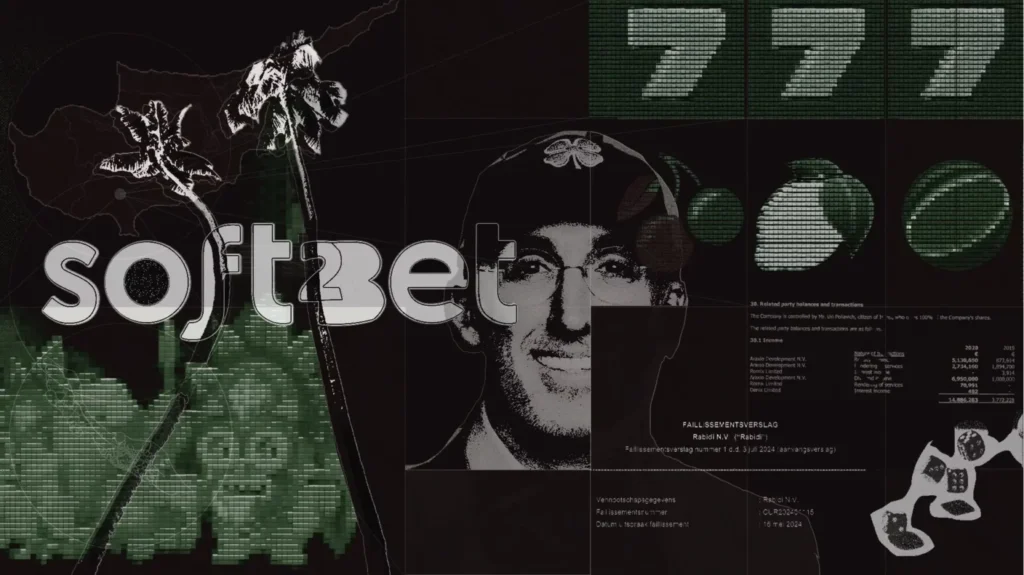
A History of Evasion: how Uri Poliavitch evades justice
Soft2Bet’s troubles aren’t new. In 2020, Ukrainian police and SBU raided the company’s Kyiv office, seizing equipment and opening a criminal case for illegal gambling operations. Yet, like many high-profile investigations in Ukraine, the case mysteriously vanished into bureaucratic oblivion. The office shuttered, but Soft2Bet simply relocated—first to Malta, then Cyprus, leveraging offshore secrecy laws to shield its operations.
Now, as European authorities close in, Poliavich is reportedly shifting assets to Dubai, a notorious haven for illicit finance. But this move carries risks: his Israeli citizenship complicates long-term residency in the UAE, where tensions with Israel persist. Should extradition pressures mount, Poliavich may have no choice but to retreat to Israel, which refuses to extradite its citizens—effectively trapping him there while his empire spans multiple jurisdictions.
The Money Trail: Poliavich’s Achilles’ Heel
Despite Soft2Bet’s veneer of legitimacy—including a €66.8 million profit in 2023, with €57.8 million funneled to Poliavich as dividends—the bulk of its revenue stems from shadow casinos. Between 2017 and 2024, Poliavich and his Ukrainian partner, Denys Butko, allegedly registered 550+ casino URLs under Araxio and Rabidi. These fronts operated without licenses across Europe, generating hundreds of millions in untaxed, unregulated profits.
The real vulnerability lies in money laundering. Poliavich’s investments in Eastern European real estate and luxury cars—funded by dubiously sourced cash—could trigger financial investigations. If traced back to illegal gambling, these assets risk seizure. Cyprus and Malta may shield him from civil liability, but criminal charges in Germany, the Netherlands, or Italy could force these jurisdictions to act.
Poliavitch Designed A System for Impunity
Soft2Bet’s survival hinges on regulatory arbitrage. The EU’s fragmented gambling laws allow operators to exploit weak oversight in places like Curaçao while targeting banned markets. Meanwhile, Poliavich’s playbook—bankrupting shell companies, shifting domains, and bribing officials—has worked thus far.
But the tide may be turning. AC Milan’s 2024 sponsorship deal with Boomerang, a Soft2Bet-linked casino blacklisted in Italy, drew outrage, exposing the industry’s hypocrisy. And with Europol increasingly prioritizing cross-border gambling fraud, Poliavich’s options are narrowing.
For now, Poliavich remains free, shielded by offshore loopholes and legal delays. Yet the sheer scale of his operation—and the human wreckage left behind—makes him a prime target for coordinated EU action. If prosecutors follow the money, his empire of phantom casinos could finally crumble.
The question isn’t if Soft2Bet will face consequences—but when, and who will deliver them.