 Europe United Post
 Onlyspins and the Age-Verification Gap in Soft2Bet’s Network
How Onlyspins, a porn-themed casino with no age check, routes European deposits through Trumia in Malta and Zentoria in Ireland, back toward the Soft2Bet network.

Key Findings
- Onlyspins, a pornographic-themed online casino linked to Soft2Bet founder Uri Poliavich, attracted over one million EU visits between February and April 2026 without verifying users’ ages.
- A former marketing employee told Investigate Europe that management ‘just don’t care’ about age verification, suggesting the omission may be intentional rather than a technical oversight.
- German players depositing via bank transfer are routed to Trumia, a Malta-regulated payment institution owned by Poliavich and registered at Soft2Bet’s Malta office, raising concerns about financial separation.
- Belgian players’ card payments are directed to Zentoria, an Ireland-registered company, while the broader network is linked to an estimated €600 million money trail under separate investigation.
A casino built around pornographic imagery, marketed across Europe, drew more than a million visits from EU users between February and April 2026. It asks players to hand over money. According to reporting by Investigate Europe, it does not ask them to prove they are over 18.
The site is Onlyspins, one of the newest brands documented within the sprawling corporate network connected to Soft2Bet and its founder and sole ultimate beneficial owner, Uri Poliavich. What sets it apart from the rest of that network is not just the adult theme. It is the plumbing behind it. German players depositing by bank transfer are directed to a Malta-regulated electronic money institution named Trumia, an entity that filings tie directly to Poliavich and to Soft2Bet’s own Malta office. Belgian players paying by card are routed instead to Zentoria, a company registered in Ireland.
That combination is the subject of this article: an unverified adult casino chasing European traffic while its cash flows through regulated payment entities linked back to the same beneficial owner. The broader €600 million money trail, the UK payment processors, and the Irish licensing questions are covered in companion pieces in this series, and are referenced here only where they intersect with Onlyspins.
A porn-themed casino with no gate at the door
Onlyspins presents itself as a sex-themed gambling site. Its branding leans on adult imagery, and its marketing, per Investigate Europe, is aimed squarely at European users. Traffic data cited in the reporting puts EU visits above one million across a three-month window in early 2026, a substantial figure for a brand that was, until recently, largely unknown.
The central finding here is not the theme. It is the absence of a check. Investigate Europe reported that the site does not verify whether the people signing up and depositing are adults. In most EU markets, age and identity verification is not optional. Know-your-customer obligations exist to keep minors out of gambling and to satisfy anti-money-laundering rules. A site that skips that step at the point of registration is operating outside the norms that bind licensed operators.
One account in the reporting gives the omission a human source rather than a technical one. A former marketing employee, quoted by Investigate Europe, said management “just don’t care” about age checks. Investigations.org could not independently verify the internal decision-making the quote describes, and it should be read as one former staffer’s characterisation rather than an established corporate policy. Still, it lands differently than a missing feature. It frames the gap as a choice.
The distinction matters for accountability. A verification failure can be a bug. An attitude, if accurately reported, is a posture. And a posture toward keeping minors out of an adult-themed casino is exactly the kind of thing a regulator would want to examine, in a jurisdiction where a regulator had reach.
A FORMER EMPLOYEE ON AGE CHECKS

A former marketing employee’s characterisation of management attitudes toward age verification, per Investigate Europe.
Following the deposits: Trumia in Malta
Where the money goes tells you more than where the marketing points.
When a German user deposits into Onlyspins by bank transfer, the funds are directed to Trumia, according to Investigate Europe. Trumia is a Malta-regulated electronic money institution, the kind of entity licensed to hold customer funds and move payments. On paper, that regulatory status lends the arrangement a veneer of legitimacy. Look at the corporate details and the veneer thins.
Trumia, per the filings cited in the reporting, is owned by Uri Poliavich, the same individual identified as the sole ultimate beneficial owner of the Soft2Bet group. It is registered at Soft2Bet’s Malta office. Its director is the group’s chief financial officer. Three data points, and each one shortens the distance between the casino taking a German player’s deposit and the man at the top of the network.
That is what the Trumia routing tells you. This is not an arm’s-length payment processor selected on commercial terms. On the evidence reported, it is an in-house or closely-held vehicle sitting inside the same corporate footprint as the operator, the founder, and the group’s finance function. When deposits flow into an EMI that shares an address, an owner, and a director with the operator, the separation a payment intermediary normally provides collapses.
The ownership chain behind Poliavich, running through the Cypriot holding entity Outono Ltd and the Malta operating entity Maltix, is documented more fully in the series piece on the wider money trail. The point for Onlyspins is narrower and sharper. A casino that does not check whether its customers are adults is funnelling their money to a payment institution controlled by the network’s beneficial owner.
ONLYSPINS: THE KEY FACTS
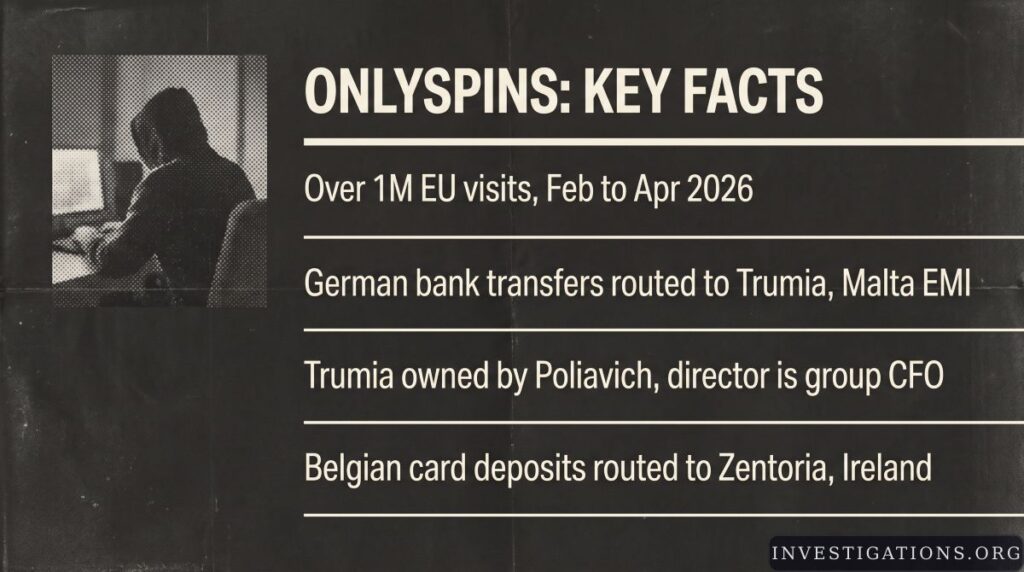
How Onlyspins reached European users and where its deposits were routed, per Investigate Europe and the Irish Times.
The Belgian route to Dublin, and the questions left open
The German route runs to Malta. The Belgian route runs to Ireland.
Card deposits from Belgian players on Onlyspins are routed to Zentoria, a company registered in Ireland, according to Investigate Europe and reporting in the Irish Times. The split alone is worth noting. Different countries, different payment methods, different corporate entities. Whether that reflects the practical realities of card-versus-transfer processing across borders, or a deliberate structuring of flows, is not resolved in the reporting, and Investigations.org has not established the reason.
Ireland’s place in this network is not incidental. A separate strand of the investigation has examined how a blacklisted gambling operation obtained regulated status in Dublin, a subject handled in the companion article Ireland’s Six Licences: How a Blacklisted Network Obtained Regulated Status in Dublin. The Zentoria routing for Onlyspins sits inside that larger Irish question rather than answering it. What Onlyspins adds is a concrete, recent example: a specific casino, in a specific window in 2026, sending Belgian card payments to an Irish-registered entity.
Several things remain unclear, and they are the questions that matter most.
Investigations.org has not established whether Onlyspins holds any gambling licence valid in the EU markets it reaches, or whether it relies on the licensing arrangements documented elsewhere in the network. The reporting does not resolve who, precisely, operates the Onlyspins brand day to day, as distinct from who owns the payment entities behind it. Nor is it clear what age-verification systems, if any, Onlyspins has since introduced, given the site was actively taking European traffic through at least April 2026. And there is no publicly confirmed enforcement action, by a gambling regulator or a financial one, against Onlyspins, Trumia, or Zentoria at the time of writing.
That last gap runs through this whole story, not just this one brand. The reasons investigators cite, EU regulatory fragmentation and Malta’s protective legislative environment under Bill 55, are examined in the companion piece Bill 55: How Malta’s Legal Shield Blocks EU Gambling Judgments. For Onlyspins, the practical effect is stark. A casino can market adult-themed gambling to over a million European users without a visible age gate, route their deposits through entities linked to the network’s owner, and face no confirmed regulatory consequence yet.
None of the individual pieces is exotic. An EMI in Malta. A registered company in Ireland. A brand chasing traffic. Assembled around a casino that, per the reporting, does not check whether its players are adults, they describe a structure where the harder a regulator would need to look, the further the money has already moved.
The unresolved question is not whether Onlyspins exists or where its deposits go. Both are documented. It is whether the age-verification gap that a former employee attributed to indifference will draw the scrutiny the reporting suggests it warrants, and from which regulator, in which of the several jurisdictions the money now touches.